‘Tis the Season

by Debbie Mascot (4/13/2026)

To register for an event or for more information, click the link for any event. All times are Pacific Time.
Questions? Email 
[email protected]

This is a guest post from CGS Member and Volunteer Maureen Hanlon, our eNews Editor.
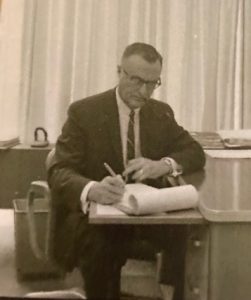
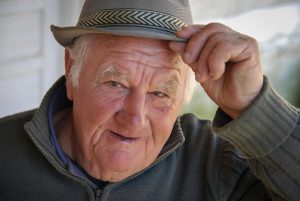
Martin J Hanlon
16 Jan 1911- 18 Apr 2001
(born and died in San Francisco, CA)


“Tax Season” Memory and Tax Record Resources 

 Growing up, January through April in our house was “tax season.” We saw very little of my dad, a Certified Public Accountant whose workdays stretched into evenings and weekends as he prepared returns for corporate and private clients. For us kids, his absence also meant a temporary suspension of our usual, somewhat formal dinnertime rituals. My mom would serve things he didn’t care for—treats to us, like canned fruit cocktail or the rare and thrilling TV dinner. What we didn’t understand then was the real nature of tax season: the arcane rules, endless details, and the maze of complex, often contradictory instructions and forms that consumed his days. And also how much tax records can reveal about a life.

Dad retired in the 1970’s and passed away on April 18, 2001, largely missing the information age and the transformation from pens, receipts, and ledgers to computers and online programs. Many of the records he grew up with and those for his parents and their parents are available, waiting to reveal facts and context for an earlier time.

Would you like to know more about what tax records can tell you about your ancestors? There are many online resources that spell out what can be found and where. If your own returns are filed, maybe you’re ready to take explore “tax season” (minus the fruit cocktail) for your family and see what you can find.

Allen County Library videos 
Using Tax Records in Genealogical Research  https://www.youtube.com/watch?v=R-0_IWplg-w
Using Tax Records to Add Context to Your Family https://www.youtube.com/watch?v=lH_2-g-83cw&t=39s

Articles
Family Tree Magazine: The Genealogists Guide to Tax Records https://familytreemagazine.com/records/other/tax-records-genealogy-guide/
Ancestry Family Learning Hub: Historical Tax Lists https://www.ancestry.com/c/family-history-learning-hub/tax-records#:~:text=What%20Information%20Can%20Be%20Found,%E2%80%9D%20instead%20of%20%E2%80%9CJohn%20Elliott%E2%80%9D
Family Locket: Back to the Basics with Tax Records Part I https://familylocket.com/back-to-the-basics-with-tax-records-part-1/#:~:text=As%20genealogists%2C%20we%20rely%20on,%2C%20inheritance%2C%20or%20other%20information.


Helpful Links
Events: https://www.californiaancestors.org/events-and-education/
Special Interest Groups: https://www.californiaancestors.org/special-interest-groups-for-members/
Calendar view: https://www.californiaancestors.org/cgs_calendar/
Tips & Talk: Oakland FamilySearch Center Family History Classes: https://www.familysearch.org/en/centers/oakland_california/classes

Newspaper Finder

by Debbie Mascot (4/9/2026)

To register for an event or for more information, click the link for any event. All times are Pacific Time.
Questions? Email 
[email protected]

Hat tip to Kristi Wessenberg for the hat tip to the Boulder Genealogical Society, who shared on Facebook recently about Newspaper Finder – a free website that acts as a directory of digitized newspapers.

Search by date range and state, and the results bring up a map with pins in all of the nearby locations they’ve identified digitized newspapers.

Choosing a pin near opens a pop up that lists the name of the newspapers and where to find them, linking directly to both free and subscription newspaper sites. This is definitely worth a try! https://newspaperfinder.com/

Helpful Links
Events: https://www.californiaancestors.org/events-and-education/
Special Interest Groups: https://www.californiaancestors.org/special-interest-groups-for-members/
Calendar view: https://www.californiaancestors.org/cgs_calendar/
Tips & Talk: Oakland FamilySearch Center Family History Classes: https://www.familysearch.org/en/centers/oakland_california/classes
Rapa Nui

by Debbie Mascot (4/6/2026)

To register for an event or for more information, click the link for any event. All times are Pacific Time.
Questions? Email 
[email protected]

I normally try to work a week or two ahead on these blog posts, but work travel has me behind and so today, Easter Sunday, I find myself writing the blogs for this week.  Naturally, while my brain was… brainstorming… I thought about family name of Easter (I got none) and then things that happened on Easter (too hard to search my database) and then places named Easter (none in my database, but why is it called Easter Island???).

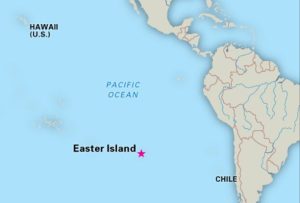
So here is why: The name “Easter Island” was given by the island’s first recorded European visitor, the Dutch explorer Jacob Roggeveen, who came across it on April 5, 1722 (Easter Sunday).  Although he was searching for something else, finding this 15-mile by 7-mile island had him name it Paasch-Eyland and the official Spanish name, Isla de Pascua, also means Easter Island.  Today, the island is called Rupa Nui.

This small, triangular-shaped volcanic island has three extinct volcanoes and is famously remote in the southeastern Pacific Ocean and the people of Rapa Nui have Polynesian genetic origins likely from the Taiwanese voyagers from 5000 years ago.  In addition, there are Native American genes from indigenous people of coastal South America.  Someone sailed from South America to Polynesia, or Polynesians reached the Americas and brought people back. Either way, it is recorded in DNA.

1862 and 1863, Peruvian slave ships raided the island repeatedly, kidnapping an estimated 1,500 people — roughly a third of the entire population — to work in the guano mines of the Chincha Islands. Among those taken were the king, the royal family, and most of the island’s oral historians and record-keepers.

International pressure eventually secured their release, but disease ravaged the survivors on the return voyage. Only fifteen people made it back to Easter Island alive. Those fifteen brought smallpox with them. By 1877, the island’s population had collapsed to 111 people. This is the genealogical ground zero for all subsequent Rapa Nui family trees — an almost incomprehensible bottleneck within a bottleneck.

The single most important document for Rapanui genealogy is the 1877 census conducted by the Chilean government. This remarkable record lists all 111 surviving inhabitants of the island by name, age, sex, and in many cases family relationship. Because every person of Rapanui descent today must trace back through this population, the 1877 census functions as the genealogical anchor for all research.

Chilean genealogist and Rapa Nui scholar Francisco Mellén Blanco produced influential work connecting later records to the 1877 survivors, and his foundational research — along with subsequent scholarship by Rapanui community historians — has made it possible to construct nearly complete descent trees for the island’s modern population.

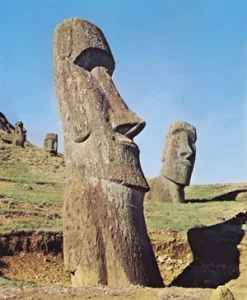
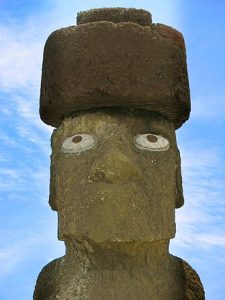
The moai of Easter Island are among the most iconic sculptures in human history — roughly 1,000 of them carved from compressed volcanic ash (tuff) quarried almost entirely from a single crater, Rano Raraku, between approximately 1100 and 1500 CE. They range dramatically in size but do not range in form— they all have long faces with heavy eyebrows, prominent noses and big ol’ chins.  We all know them, but I did not know that they used to have hats!

Helpful Links
Events: https://www.californiaancestors.org/events-and-education/
Special Interest Groups: https://www.californiaancestors.org/special-interest-groups-for-members/
Calendar view: https://www.californiaancestors.org/cgs_calendar/
Tips & Talk: Oakland FamilySearch Center Family History Classes: https://www.familysearch.org/en/centers/oakland_california/classes