To register for an event or for more information, click the link for any event. All times are Pacific Time.
Questions? Email [email protected]
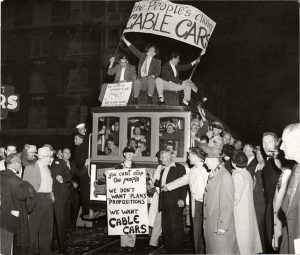
The Jukebox this month got me to thinking about the cable car controversy that prompted the Song/Advertisement that was posted. I didn’t know about this so I set off to learn more and went down some rabbit holes (as I tend to do).
By the mid-1940s, San Francisco’s transit system was struggling. Years of heavy wartime use and deferred maintenance had left the cable car infrastructure in poor condition. City leaders, including Mayor Roger Lapham, argued that the aging system was expensive, outdated, and impractical. Modern buses were promoted as a more efficient solution, and plans were announced to replace the Powell Street cable car lines entirely. To many officials, the cable cars were little more than worn-out relics and financial burdens. Supporters of modernization viewed their removal as a necessary step toward the city’s future.
Not everyone agreed.
Leading the opposition was Friedel Klussmann, a civic activist who organized the Citizens’ Committee to Save the Cable Cars. At a time when city politics and business leadership were overwhelmingly male, Klussmann and a coalition of women launched a determined public campaign. They researched the issue, challenged official claims, and argued that the cable cars represented something far more valuable than a balance-sheet expense. They were a living piece of San Francisco’s history, the last surviving cable car system in the United States, and a symbol of the city’s unique identity.
The campaign quickly became a citywide controversy. Newspapers debated the issue, politicians took sides, and voters were asked to decide the cable cars’ fate. Preservationists accused city leaders of using political maneuvering and behind-the-scenes tactics to push the system toward closure, while supporters of removal insisted that sentimentality should not outweigh practical transportation concerns. The battle reflected larger postwar debates taking place across America, where older transit systems were being replaced by automobiles, buses, and freeway construction.
In November 1947, San Francisco voters delivered a decisive verdict. By a margin of more than three to one, they approved a measure protecting the Powell Street cable car lines. Additional efforts in the following years preserved portions of the remaining network, although not every route survived. The five-line system that existed before the controversy was eventually reduced and reorganized into the three cable car lines that continue operating today. Despite those losses, the preservation movement succeeded in saving the heart of the system.
The cable car controversy remains an important reminder that historic preservation often depends on ordinary citizens who are willing to challenge powerful interests. What many officials once dismissed as obsolete transportation is now one of the world’s most recognizable urban landmarks. Thanks to Friedel Klussmann and the activists who fought for their survival, San Francisco’s cable cars continue to climb the city’s hills nearly eighty years later, carrying both residents and visitors through a moving piece of history.
Sources:
https://www.streetcar.org/75-years-ago-cable-car-war/
https://www.sfmta.com/blog/75-years-after-battle-save-cable-cars
https://www.sfcablecar.com/history.html
https://www.facebook.com/groups/remembered/posts/1316732925195222/
https://sfcablecars.org/stories/politics-tricks-cable-cars
Helpful Links
Events: https://www.californiaancestors.org/events-and-education/
Special Interest Groups: https://www.californiaancestors.org/special-interest-groups-for-members/
Calendar view: https://www.californiaancestors.org/cgs_calendar/
Tips & Talk: Oakland FamilySearch Center Family History Classes: https://www.familysearch.org/en/centers/oakland_california/classes