
A Rude Awakening

by Debbie Mascot (4/27/2026)

To register for an event or for more information, click the link for any event. All times are Pacific Time.
Questions? Email 
[email protected]
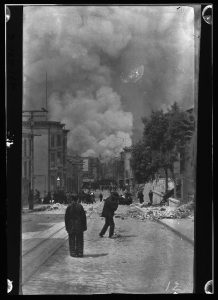
Saturday before last marked the anniversary of the San Francisco 1906 earthquake.  At 5:12 a.m. on April 18, 1906, the residents of San Francisco got the worst alarm clock in history. The ground started rolling thanks to a massive rupture along the San Andreas Fault, and in less than a minute, buildings were down, chimneys were flying, and everyone was suddenly very, very awake.

And just when things couldn’t get worse…they did. Fires broke out across the city and burned for three days. Three. Days. By the time things settled down, much of San Francisco looked less like a bustling city and more like a campfire that got wildly out of hand.

While a lot of folks stayed and rebuilt, many others left.  Oakland and Sacramento saw an influx of new inhabitants and still others decided to get a second home outside of what they thought of as earthquake zone.  One of these such families was “my” Mariani family.  They found a ranch in Portola Valley so that in case there was another earthquake they had somewhere to go.

My great grandfather was a caretaker on that ranch and later my father followed in his footsteps.  Recently I visited the Ravenswood historic house in Livermore and that ranch had the same story.  The family built the house after the earthquake to have a retreat just in case.   It was surprising how much that frozen-in time ranch had in common with the one I grew up on in Portola Valley.

I’m not sure what the moral of this story is, other than to find your personal connection to moments in time and then jot it down so that it becomes part of YOUR story. And also…  if you are buying a ranch in Portola Valley to escape earthquakes, maybe make sure the same fault line doesn’t cut through your property…

Photo Source:
Genthe, Arnold. (1906). San Francisco, April 18, 1906 [Online image]. Library of Congress. https://www.loc.gov/pictures/item/2018705023/

Helpful Links
Events: https://www.californiaancestors.org/events-and-education/
Special Interest Groups: https://www.californiaancestors.org/special-interest-groups-for-members/
Calendar view: https://www.californiaancestors.org/cgs_calendar/
Tips & Talk: Oakland FamilySearch Center Family History Classes: https://www.familysearch.org/en/centers/oakland_california/classes
Prose and Cons

by Debbie Mascot (4/23/2026)

To register for an event or for more information, click the link for any event. All times are Pacific Time.
Questions? Email 
[email protected]

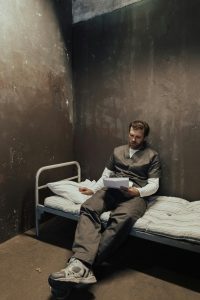
The California State Library has digitized an incredible (and honestly, slightly unexpected) collection: historical periodicals from 21 California correctional institutions, spanning 1915 to 1991. Yes—prison newspapers. And yes—they are every bit as interesting as you’re hoping.

These weren’t just dry institutional bulletins. Many of these publications were written and edited by incarcerated individuals themselves. Think articles, poetry, opinion pieces, creative writing, and glimpses into daily life behind bars.

For genealogists, this is the kind of material that makes you sit up a little straighter and say, “Okay, now this is interesting.”  First of all, finding an incarcerated ancestor is practically golden.  But to find their written words?  Put those with the court records and call it a book!

If you had an ancestor who spent time in a California correctional institution, you might find:

  • Mentions of individuals by name
  • Articles written by or about inmates
  • Personal stories and reflections
  • Clues about daily life, relationships, and community

You might discover something unexpected about your family history. But genealogy isn’t about curating a perfect story—it’s about telling a real one. And this collection offers a rare chance to hear voices that are often missing from traditional records.

https://csl.primo.exlibrisgroup.com/discovery/collectionDiscovery?vid=01CSL_INST:CSL&collectionId=81211374490005115&lang=en

I don’t know (yet) of any prisoner ancestors, but I did take a tour of Soledad prison in college.  Pulling up the June 2, 1975 Soledad Star News, there are some really interesting articles about female guards being a new thing, chicken on the menu, and everyone, I mean EVERYONE, has a nickname.  I then decided to pull up the issue from 1956.  My favorite section is called, “Prose and Cons” (see what they did there??!).  They have little tidbits, like this:  “YOU SAID IT! In the corridor:  … In F wing: ‘Well, he may not be a thief—but I’ll bet when they’re carrying him to the cemetary (sic) he reaches out and snatches a bouquet as the procession marches along.(Soledad Star-News (Soledad, California), 7 December 1956, page 4, column 3, in California Prison Press, California State Library digital collection of periodicals from California correctional institutions, 1915–1991 (https://www.library.ca.gov : accessed 18 April 2026).)

Check it out and see if you can find any treasures!

Helpful Links
Events: https://www.californiaancestors.org/events-and-education/
Special Interest Groups: https://www.californiaancestors.org/special-interest-groups-for-members/
Calendar view: https://www.californiaancestors.org/cgs_calendar/
Tips & Talk: Oakland FamilySearch Center Family History Classes: https://www.familysearch.org/en/centers/oakland_california/classes

The Not-So-Fun Part of Writing

by Debbie Mascot (4/16/2026)

To register for an event or for more information, click the link for any event. All times are Pacific Time.
Questions? Email 
[email protected]

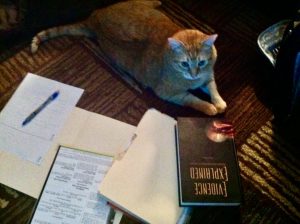
The late, great Jones2 “helping” me write


I try to cite my sources, but sometimes (see Easter post from last week), I just run rampant collecting info and forget to write down where I went.  I have special sticky notes from the Silicon Valley Computer Genealogy Group (link) and a notepad and try to open a new tab in my browser when I go to a new place, but sometimes I just forget.  Or when I do have all the info, I just can’t find my Elizabeth Shown Mills’ book (it’s next to me on the desk, but I’d have to move all the charging things to get to it, so…).

Many moons ago, when I wrote a book about my not-family Marianis, I found out that I have a really bad memory.  Even though almost all of my sources were from the same place, I couldn’t remember what to do.  So I created a personal cheat-sheet of my common sources.  I put it into my notebook in a sheet protector and could easily get to my most common sources.

Here is a link to that: https://www.dropbox.com/scl/fo/8j82jz6dlxg7ed3ou4bqs/AE7HiXQvCj-9DJU3ARpajko?rlkey=0ebgofbiscpmn73mmlt699uce&st=t15tonic&dl=0

Feel free to download and add your own most common.  And I am going to try to remember to be better at citations…

Sources:
Mills, Elizabeth Shown. Evidence Explained: Citing History Sources from Artifacts to Cyberspace. Revised edition. Baltimore: Genealogical Publishing Co., 2009.

Helpful Links
Events: https://www.californiaancestors.org/events-and-education/
Special Interest Groups: https://www.californiaancestors.org/special-interest-groups-for-members/
Calendar view: https://www.californiaancestors.org/cgs_calendar/
Tips & Talk: Oakland FamilySearch Center Family History Classes: https://www.familysearch.org/en/centers/oakland_california/classes