Family Tree Maker SIG Goes Virtual

by Jennifer Dix (5/25/2020)

The Family Tree Maker Special Interest Group, co-facilitated by Ron Madson and Karen Halfon, became our first CGS Special Interest Group (SIG) to take its meetings to the Internet.  The regular meeting of the group was held online on Zoom on May 16, 2020 at 1:00 pm.  The official meeting was ushered in by a “social hour” beginning at 12:30. Attendees were free to chat with each other or ask questions before the meeting started.

A notable guest to this virtual event was Russ Worthington (“Cousin Russ”), who authors the blog “Collecting Cousins.” He contributed updates and insights on the progress, status, and functioning of the new FTM release.  We may be seeing him in upcoming virtual meetings.
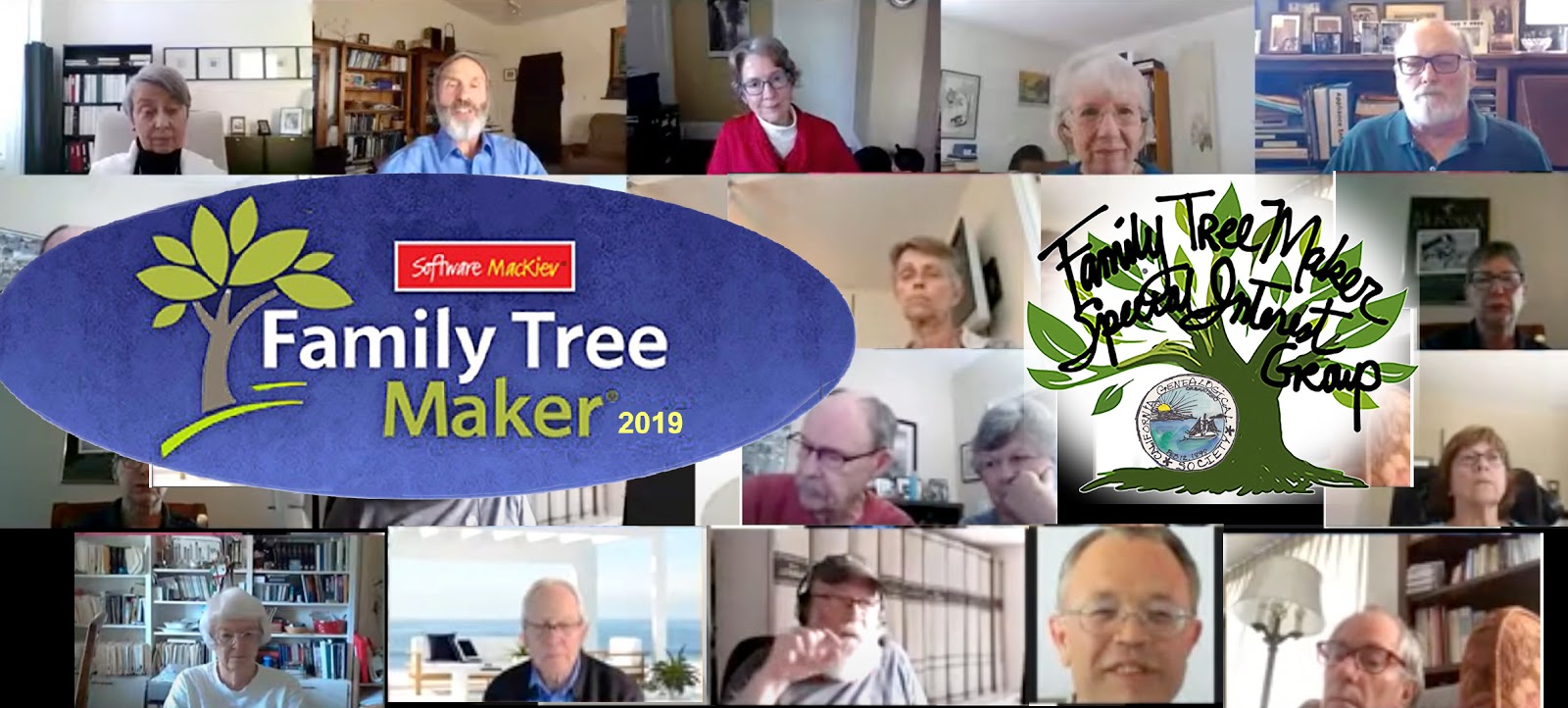
The Family Tree Maker Special Interest Group met online this month
The topic for this meeting was a discussion of the newest release of the FTM software, FTM2019.  The agenda included new features of the software program including a function called “TreeVault” which allows users to upload a tree to the vendor’s (Software MacKiev) cloud storage. The Vault-saved tree is updated in real time with every update or change made to the FTM tree and can be restored to the user’s computer when and if necessary.  
A video recording of the meeting is posted on YouTube: 

The FTM-SIG plans to continue the monthly Zoom meetings during these shelter-in-place times, at the usual time on the third Saturday of the month. The June 20th meeting program will focus on “Family History Fact and Event Management Tools.” For more information, contact:
Ron Madson ([email protected])
or Karen Halfon ([email protected]).

Copyright © 2020 by California Genealogical Society

Online Genealogy, Week of May 25-31

by Jennifer Dix (5/23/2020)

Here are some online genealogy events offered this week. Most are free. See our post Genealogy Learning in the Time of Coronavirus,”for links to archived classes at Ancestry, FamilySearch, RootsTech, and more. The National Genealogical Society also offers some free resources online.
Don’t miss the two CGS online classes offered this week!
May 28: The Chinese Exclusion Files: A Treasure Trove of Original Documents by Trish Hackett Nicola
May 30: 20th-Century Immigration and Naturalization Records by Marisa Louie Lee

Legacy Family Tree and MyHeritage offer these webinars:

May 26: Enlightened Design with the MyHeritage Chart Creation Tool by Janet Hovorka

May 27: Mistrust Transcriptions: And Here’s Why by Dr. Bruce Durie 

May 29: Fridays in May: Your Questions Answered LIVE—More Tech with Thomas by Thomas MacEntee 
Also, Legacy Family Tree continues to unlock one archived webinar per day through the month of May. The classes follow a 7-day rotating theme:
Sundays – Methodology
Mondays – DNA
Tuesdays – Ethnic Genealogy
Wednesdays – TechZone
Thursdays – Around the Globe
Fridays – Beginners
Saturdays – Technology

May 25: Which Spot Does X Mark, Anyway? X-DNA Testing in Action by Debra Renard
May 26: Jewish Genealogy for the Non-Jew: History, Migration, DNA by Schelly Talalay Dardashti
May 27: Need a Fillable Form? Word Has Your Back! by Amie Bowser Tennant
May 28: Effective Use of GENUKI: England’s Largest Free Genealogy website by Paul Milner
May 29: 1910-1940 Federal Censuses & State Censuses to Fill in the Gaps by Amie Bowser Tennant
May 30: Microsoft Word Series: Getting Started with Microsoft Word by Thomas MacEntee
May 31: Ten Tools for Genealogical Writing by Harold Henderson

Conference Keeper lists many of the above, as well as the following:
May 26:  United States Vital Records Overview (FamilySearch)

May 26: Strategies to Analyze Endogamous DNA by Alec Ferretti (Virtual Genealogical Association)
May 26: Documenting An Ancestor, Seema Kenney (Thomas Crane Public Library)

May 27: “Homestead Act” by Peter Summers (Pinellas Genealogy Society)
May 28: “The Pursuit of Happiness and the Migration Experience: Faith, Land and Hope” by Wolfgang Grams (Germanic Genealogy Society)
May 28: Using Non-Population Schedules for Context and Evidence with Jill Morelli (Florida State Genealogical Society)
May 31: “Finding B. Berman: A Case Study in Getting Past a Genealogical Brick Wall” by Martin Fischer (Jewish Genealogical Society of Illinois)

May 31: Scottish Genealogy Workshop by Paul Milner (Heinz History Center)
May 31: Food: A Window on Jewish Life, Culture, and Genealogy, by Joan Nathan (Jewish Genealogical Society of Greater Boston)

Stay safe, be well, and happy learning!
Copyright © 2020 by California Genealogical Society
Religion and Politics: A Korean Family’s Journey to Hawaii

by Jennifer Dix (5/22/2020)

Cindy Kim Thomson shares this story of her Korean missionary ancestors

In 1904 my second-great-grandparents, Chang Sung and Chu No (Rebecca) Kim, immigrated to Hawaii from Hamhung in northeast Korea.  Accompanying them aboard the SS Gaelicwas their only child, my great-grandmother Nak Kull Yee, with her husband and two small children. Nak Kull’s stories have been passed down in my family for generations: how her parents were converted by American Christian missionaries in Korea, how – during seasonal lulls in activity on their farm – they trekked hundreds of miles north (even crossing a frozen river) to proselytize in Manchuria, and how fearful they were of encountering tigers along the way. 

Hamhung and Manchuria are on opposite sides of the mountain ranges that run down the spine of the Korean peninsula. Considering the topography, was it even possible for Chang Sung and Rebecca to make that trek to Manchuria?  How could they proselytize in Manchuria when they couldn’t even speak Chinese? And did tigers really live in Korea?  I looked to histories of Korea and biographies and memoirs of the missionaries for answers to these questions.

Korean print depicting a tiger
(National Museum of Korea, Seoul)
According to early Korean church records in Honolulu, Chang Sung and Rebecca were baptized in Korea by the Reverend William Arthur Noble. Noble had arrived in Korea in 1891 and in 1896 took charge of the Northern Presbyterian Mission based in Pyongyang (then known as the “Jerusalem of the East”), now the capital of North Korea.


During the late 1800s and early 1900s (Chang Sung and Rebecca’s last years in their homeland), the mountains of northern Korea were prime tiger habitat. So great was the fear of these animals that some villages hired tiger hunters for protection. Tiger skins were the insignia of high office and also used on carrying chairs of the nobility, their teeth and claws used for ornaments, and ground-up bones for medicine. The tiger (now extinct in Korea) remains an iconic figure in Korean folklore.

The Yalu and Tumen rivers comprise the northern border between Korea and China. To escape famine and economic and political oppression, Koreans sometimes crossed these rivers (which froze over for months in the harsh weather) to find work in Manchuria or Siberia. In the late 1800s, about 70,000 Koreans were living in Manchuria. Chang Sung and Rebecca were likely preaching to fellow Koreans rather than to Chinese in Manchuria. 


In the spring of 1891, Presbyterian missionaries James Gale and Samuel Moffett, accompanied by an early convert named So Sangyun, left Seoul for a three-month, 1400-mile journey that included territory covered by the Northern Presbyterian Mission. Details of their journey are recounted in Richard Rutt’s A Biography of James Scarth Gale and His History of the Korean People (1972). Of particular interest to me was the portion of their trip where they visited Korean Christian villages in Tonghua, Manchuria, then crossed the Yalu River and stopped in the Korean towns of Chasong, Changjin and Hamhung. This route took them through the “immense Yalu forests” (suggestive to me of tiger habitat), the Yalu valley where “there were still seven or eight feet of ice in the ravines,” and the “fertile rice valleys” around Hamhung. I don’t know if Chang Sung and Rebecca followed the missionaries’ route, but I am no longer skeptical of Nak Kull’s stories of their travels between Hamhung and Manchuria.    

Korean immigration to Hawaii peaked during 1903-1905. Many Christian missionaries encouraged their congregants to find a better life and proselytize in Hawaii. Every ship departing from Korea included at least one minister who uplifted the Christians and reportedly annoyed some of the non-Christians. It’s no wonder that Christians were disproportionately represented among the Korean sugar plantation workers in Hawaii. Because the Presbyterians did not have a presence in Hawaii, Chang Sung worked for the Methodist Hawaiian Mission ministering to the Koreans at Pahala Plantation. He died in 1916, and Rebecca died in 1923.

Photo of Nak Kull, about 1952

Nak Kull raised eight children and outlived three husbands and a beloved son who died at age 24.  In 1950, just before the outbreak of the Korean War, she received word that her cousins in Korea had fled to the south from their home in now-Communist Hamhung. In 1952, when fighting on the battlefield had diminished, Nak Kull left for Korea to find her cousins at a squalid refugee camp in Busan. Her children, who had futilely objected to her departure, sent her money and goods to sell on the black market. Nak Kull died in South Korea. In 1957, her ashes were shipped to Honolulu (presumably by her cousins) and scattered at Koko Head after a service at the Korean Christian Church.

CIndy Thomson photo
Cindy Thomson’s interest in genealogy began with family stories about her immigrant ancestors in Hawaii and evolved into an obsession over the past 15 years. After retiring as a Commerce Department economist, she moved to Oakland and started taking classes at CGS.  She also volunteers as a CGS Library and event assistant, and teaches a class on “Immigrant Sugar Plantation Workers in Hawaii: A Multi-ethnic Approach to Genealogy.” 
 

Copyright © 2020 by California Genealogical Society