
To register for an event or for more information, click the link for any event. All times are Pacific Time.
Questions? Email [email protected]
Today’s Post is Courtesy of Janet Netz, CGS Member and Volunteer
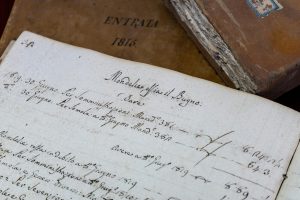
How I Used ChatGPT to Help Process the Addington–Davis–Huntingdon Manuscript Collection
Genealogists often dream of having a research assistant, someone who can read every document carefully, remember every detail, and instantly point you to the relevant source when you need it. While working on the Addington–Davis–Huntingdon (ADH) manuscript collection at the California Genealogical Society, I discovered that tools like ChatGPT can come surprisingly close.
The Addington–Davis–Huntingdon (ADH) collection is a set of handwritten letters exchanged among family members and friends in the Midwest between about 1885-1925. As a co-chair of the CGS Manuscripts Committee, my goal in working with this collection was twofold: to digitize the letters so CGS members can access them online, and to create a detailed finding aid—in other words, a list describing the documents in the collection and how they relate to one another. Projects like this are exactly the kind of work done by the CGS Manuscripts Committee, where volunteers help make unique historical materials accessible to researchers.
Transcribing the letters
The first step was scanning all of the letters. Once I had digital images, I worked with ChatGPT to produce transcriptions. I uploaded JPG images of each letter and asked ChatGPT to draft a transcription. I gave it several specific instructions: keep the original line breaks, preserve the spelling exactly as written, flag any words it was unsure about, and never invent missing text.
ChatGPT did a surprisingly good job. The transcriptions were not perfect, but they were an excellent starting point and significantly sped up the process. Instead of starting from scratch with each letter, I could review the draft transcription, compare it to the original image, and correct any errors. I also used ChatGPT to help research unfamiliar references that appeared in the letters. For example, one letter mentioned Flinch cards, a card game popular in the early 1900s. Learning about things like that helped me add explanatory footnotes to the transcriptions.
Dating and connecting the letters
Once the letters were transcribed, the next challenge was putting them into chronological order. Many letters were not fully dated, so ChatGPT helped me analyze clues within the text and correlate them across multiple letters. For example, one letter written from Iowa mentioned women voting. ChatGPT pointed out that Iowa was debating women’s suffrage in 1919, which helped me infer the likely date of the letter. By connecting references like this across the collection, I was able to infer approximate dates for every undated letter.
One particularly helpful aspect was ChatGPT’s ability to act as a kind of “extended memory.” Even with this relatively small collection of about 150 letters, it was impossible for me to keep every detail of every letter in my head. For example, Several letters referred to the death of an infant, and I initially assumed they all referred to a single known loss in the family—Leslie Davis Addington, who died in 1903. When I asked ChatGPT to identify every letter that mentioned an infant death, however, it grouped those references together and showed that some clearly referred to an earlier loss around 1898. That prompted me to investigate further, and I was able to confirm through genealogical records that there had indeed been an earlier infant who died in that period.
Creating the finding aids
Finally, ChatGPT helped me draft descriptions of the collection that will ultimately appear in the finding aid on the CGS website (coming soon). Writing clear descriptions of a manuscript collection requires summarizing themes, identifying correspondents, and explaining how the documents relate to one another. ChatGPT helped turn my notes into clear, readable summaries.
ChatGPT did not replace my judgment or expertise; it is like having a very eager assistant. Every transcription had to be reviewed against the original letter, and every historical reference had to be checked. But as a research assistant, ChatGPT was extremely helpful. It allowed me to work through the collection faster and more systematically than I could have done on my own. For genealogists working with family letters, diaries, or other handwritten documents, tools like ChatGPT can be very useful. They won’t do the genealogy for you—but they can make the process of organizing, transcribing, and understanding historical documents much easier. If you have a set of family letters, a diary, or even a thick probate file, you might consider experimenting with AI as a research assistant. You may find that it helps you see patterns—and connections—you might otherwise miss.
Postscript
ChatGPT also assisted in drafting this blog post. I reviewed and edited all material suggested by ChatGPT.
Interested in helping with CGS manuscript collections?
The CGS Manuscripts Committee welcomes volunteers. If you would like to help process historical collections like the Addington–Davis–Huntingdon papers, please contact Janet Netz ([email protected]) or Laura Jones ([email protected]). We meet Mondays at the CGS library.
https://www.californiaancestors.org/manuscript-collection/
Helpful Links
Events: https://www.californiaancestors.org/events-and-education/
Special Interest Groups: https://www.californiaancestors.org/special-interest-groups-for-members/
Calendar view: https://www.californiaancestors.org/cgs_calendar/
Tips & Talk: Oakland FamilySearch Center Family History Classes: https://www.familysearch.org/en/centers/oakland_california/classes
MAR
2026