
To register for an event or for more information, click the link for any event. All times are Pacific Time.
Questions? Email [email protected]
Twice a year, most of us shuffle around the house adjusting clocks, grumbling at the lost hour of sleep in spring or enjoying the brief gift of an extra hour in fall. Where did this whole “time change” idea begin?
Before the late 1800s, there was no such thing as standardized time in North America. Noon was simply when the sun reached its highest point in your community — meaning every town ran on slightly different time. And this was just fine… until trains entered the picture.
When railroads started crossing the US and Canada, each station with their own local time was chaos. Trains couldn’t keep schedules and people couldn’t figure out arrival and departure times. On November 18, 1883, North American railroads implemented the first of a standardized time system: Standard Railway time, which created the four time zones.
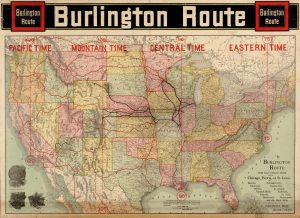
Source: https://guides.loc.gov/this-month-in-business-history/november/day-of-two-noons
Nearly a hundred years earlier, Benjamin Franklin joked about saving candles by waking earlier in the summer, but the first real Daylight Saving Time policy came during World War I, when several countries adopted it to save fuel and energy. The U.S. adopted Daylight Saving Time in 1918, abolished it after the war, and reinstated it during World War II for similar reasons. After World War II, states and cities made their own decisions and chaos returned.
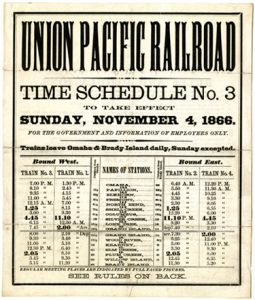
Source: https://www.uprrmuseum.org/uprrm/exhibits/curators-corner/employee-timetables/index.htm
In 1966, the Uniform Time Act allowed States to opt out (Arizona and Hawaii still do not participate), and noted that if you did participate, Daylight Saving Time began on the last Sunday in April and ended the last Sunday in October. That schedule has been revised many times until we are now at the second Sunday in March/first Sunday in November schedule that we are on now. begins on the second Sunday of March and ends on the first Sunday of November.
The concept of saving energy with a time change was to align waking hours with natural daylight. By setting the clocks forward, people spend less time in the dark during the morning and gain an hour of light in the evening. Theoretically, this reduces the energy needed to light and heat during these months. That said, we now have air conditioning which takes more electricity than the lights that everyone was worried about at the time…
So is it efficient? Is it smart to continue? I don’t know. But what I do know is that once we change that clock on Sunday morning, I’ve got more spring in my step, and my need to curl up with a book and a hot beverage wanes. When it ends in November, I get excited for the book/beverage nights again, though.
Sources:
- Ayers, E., Onuf, P., and Balogh, B. (Hosts). (2015, March 6). On the Clock [Podcast episode). In Backstory. Virginia Humanities. https://backstoryradio.org/shows/on-the-clock-4/
- Buckle, A., & Kornberg, S. (n.d.). History of Daylight Saving Time (DST). Time and Date AS. https://www.timeanddate.com/time/dst/history.html
- McMillan, A. (2022, November 7). The history of Daylight Saving Time. Coloradan, University of Colorado Boulder. https://www.colorado.edu/coloradan/2022/11/07/history-daylight-saving-time
- Bureau of Transportation Statistics. “History of Time Zones and Daylight Saving Time (DST).” Bureau of Transportation Statistics, U.S. Department of Transportation, 17 Jan. 2023, bts.gov/explore-topics-and-geography/geography/geospatial-portal/history-time-zones-and-daylight-saving.
Helpful Links
Events: https://www.californiaancestors.org/events-and-education/
Special Interest Groups: https://www.californiaancestors.org/special-interest-groups-for-members/
Calendar view: https://www.californiaancestors.org/cgs_calendar/
Tips & Talk: Oakland FamilySearch Center Family History Classes: https://www.familysearch.org/en/centers/oakland_california/classes
MAR
2026